
The Invisible Thread: Why the Circular Economy Needs to Connect Processes
Published Aug 2026 © DATA4CIRC
Have you ever wondered why we don’t just recycle everything? It is difficult to truly recycle, remanufacture, or refurbish complex objects, like a smartphone or a car engine. But what makes it so complicated? What is stopping us?
The challenge of circularity
When we think about circularity as the application of R-strategies, such as repair and recycle, the biggest bottleneck is rarely the physical technology. We have machines that can shred plastics and chemically recover metals, and robots capable of disassembling components. The real challenge is information.
To reuse, repair or recycle a part, we need to know a lot about the product, for example:
- What is it made of?
- How was it treated?
- Has it already been recycled?
- If so, how many times and what processes were used?
Currently, that information can get stuck in “silos”, meaning it is trapped inside different software systems used across a product’s lifecycle, from its design to its end-of-life. However, in many cases, information from manufacturing processes is not even recorded due to a lack of parameter measurement, or, even when it is measured, it is not further processed or stored. This results in important information gaps, leaving a product’s history a total mystery. When an R-strategy is applied to the end of the product’s lifecycle, this uncertainty makes the process risky and expensive.
This is where the DATA4CIRC Digital Thread comes in. It is the secret ingredient for a sustainable manufacturing future, allowing value chain companies to seamlessly collect data from their processes and make the most of it.
What is the Digital Thread? (A Simple Analogy)
Think of the Digital Thread as being like a rail network.
In this world:
- The products are the ‘trains’.
- The products’ lifecycle stages are the ‘stations’.
- Data about the products are the ‘passengers and cargo’.
Thus, a train can travel from its point of origin to its destination, stopping at various stations along the way (i.e. from the design of a product to its end of life). The route to the next station has its own characteristics (e.g. speed, fuel consumption, duration) and, upon arriving at each station, the train is ‘updated’ (e.g. passengers board, cargo is unloaded, or a railcar may be replaced if an incident has occurred along the route).
Thinking of it like a rail network, it is easier to understand the definition of a digital thread adopted in the DATA4CIRC project: “a communication architecture that enables a seamless flow of data and an overall view of the asset’s data during its entire lifecycle”.
The digital thread is a communication backbone that replaces separate sets of data stored in unlinked files and silos, and creates a continuous record that connects all product-related data: beginning with design and running through the product’s manufacturing, its operational use and, finally, to its end-of-life and the recovery of materials. The Digital Thread concept is illustrated with the railway analogy below.
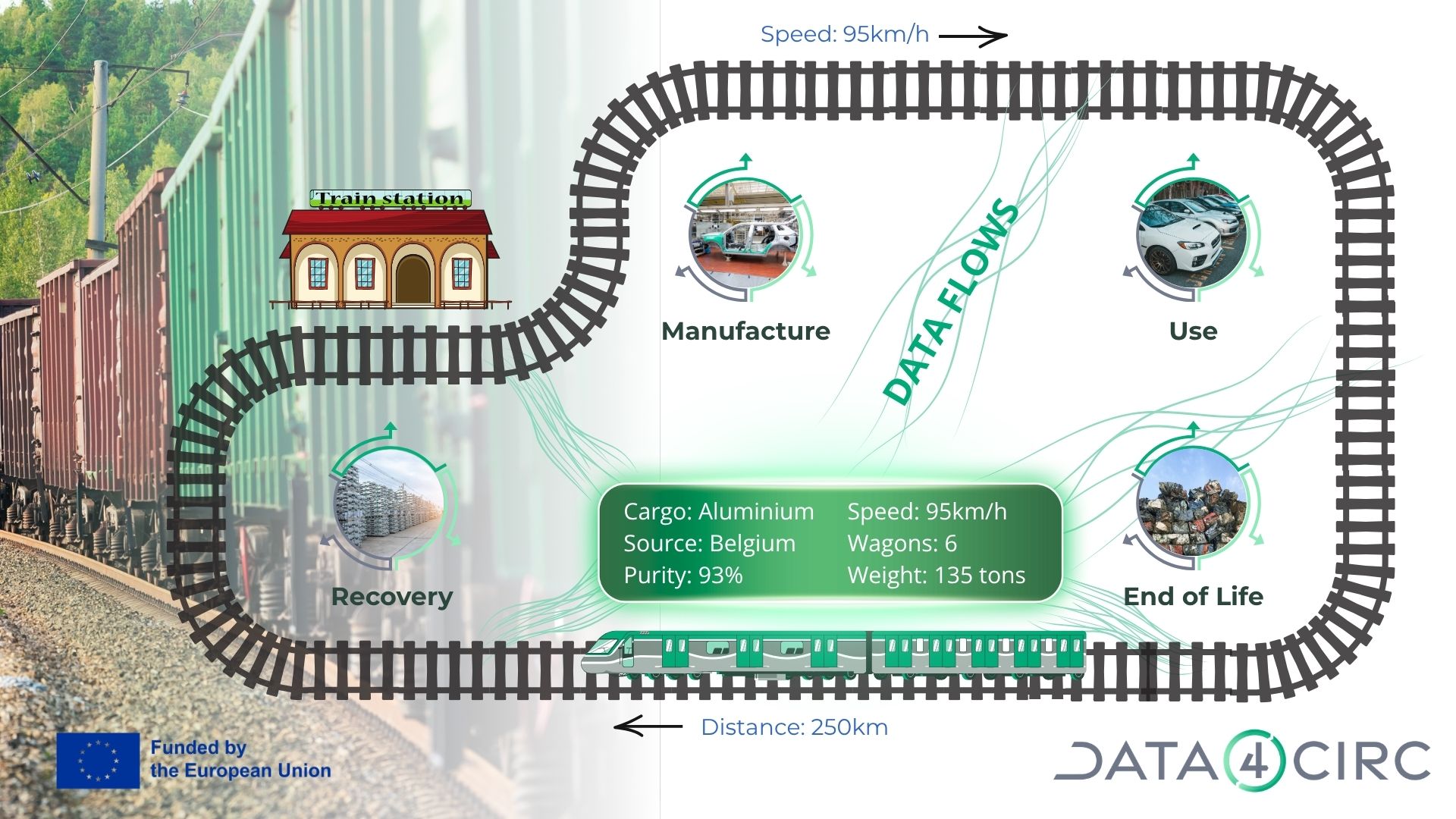
Digital Threads – the railway analogy © DATA4CIRC 2026
How it Works: Cleaning the “Data Mess”
Continuing with the railway analogy, all the passengers on our train are unique and travelling for different reasons. A business traveller with a briefcase might need a small table to work on their laptop during the journey, while tourists carrying multiple suitcases might need extra luggage room and prefer to watch a film on their way to their destination. Manufacturing data is similar: it is often variable and messy – it might come from a variety of heterogeneous sources systems that usually do not speak the same language (e.g. robotic sensors on fast-moving production lines, hand-written notes in logistics spreadsheet, or complex chemical test results).
The Digital thread operates like a high-speed digital sorting machine that cleans the data up that ensure that “all passengers have space on the train and get the right seats in the right carriages” (see below).
This is structured into special strands or parallel channels called Digital Fibres. Each fibre is uniquely mapped to a step of the product’s lifecycle and, within each value chain, the fibres are logically sequenced to reflect the order of lifecycle stages, similar to how first class, second class, dinner cars, silent carriages etc. are organised within a train depending on the passengers’ needs. For the project’s automotive use case, there might be a “catalytic converter collection fibre” that specifically collects and cleans data obtained from inventorying spent catalytic converters, and a “catalytic converter metal extraction fibre” that will do the same for the data obtained during the extraction of valuable metals.
A crucial part of this process is adding metadata. This sounds technical, but think of it like the different digital labels that enable the traceability of each piece of information, or like the passenger list on the train that might contain data about where each passenger embarks, their destination, how they booked their ticket, reason for travel etc.
Metadata ensures that, when data enters the thread, we can know exactly where it came from (accountability), when it was created (reliability), and that it is in a format everyone understands (standardisation). This standardised data is essential for maintaining data privacy and trust (GDPR compliance) and is what makes DATA4CIRC’s Digital Thread robust.
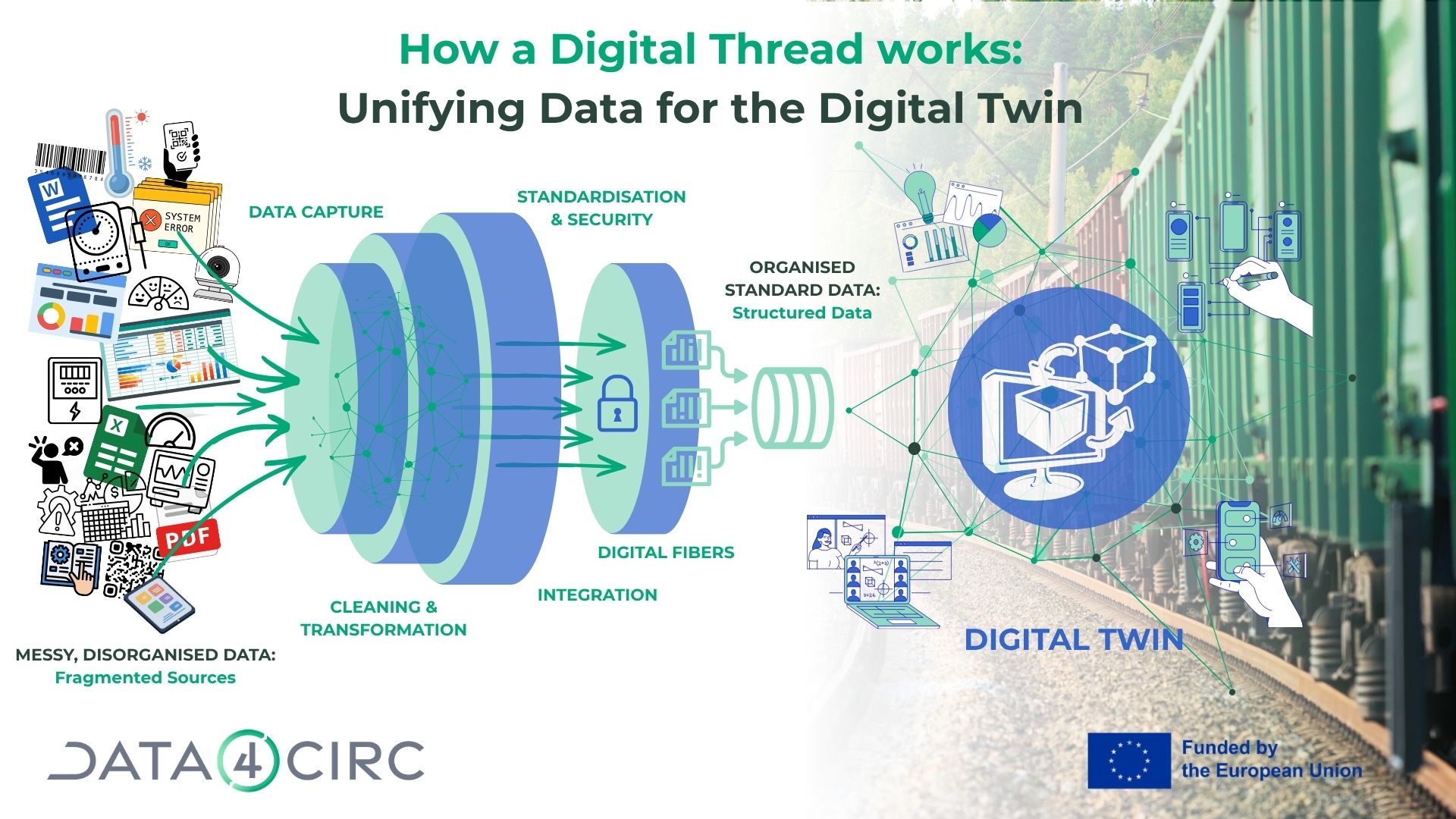
How a Digital Thread works © DATA4CIRC 2026
The DATA4CIRC Goal
In DATA4CIRC, the purpose of the Digital Thread is not to store data; it is to “feed” the product Digital Twin, enabling it to run simulations and make predictions. By implementing the Digital Thread across our key use cases (plastics, electronics, and automotive sectors), the project is building a foundation of trust and transparency. Through this, we will show that data can be managed securely and in a way that respects data sovereignty (meaning companies control their own data), while enabling the deep collaboration required for circular value chains.
Ultimately, a Digital Thread is not just a technical tool; it is the foundation of trust that circular value chains need to scale. Without it, circularity remains a promise. With it, it becomes a process.
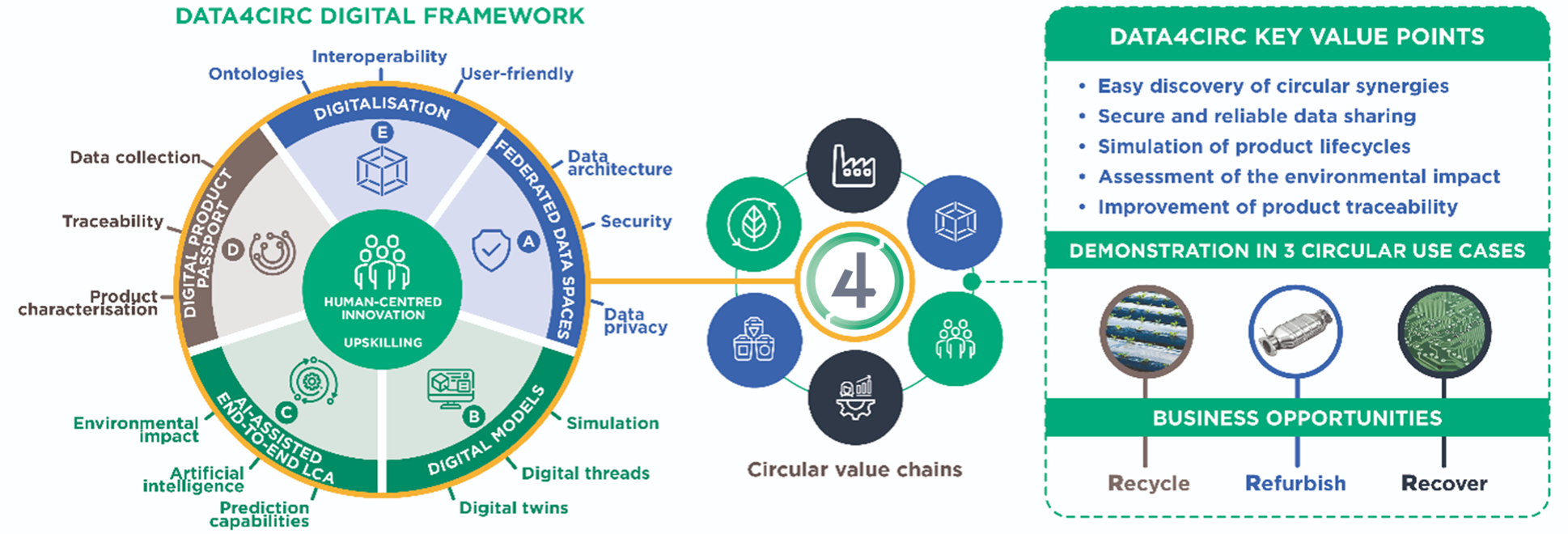
The DATA4CIRC concept © DATA4CIRC 2026
We hope you found the railway analogy useful and can understand how Digital Threads work! Keen to know more? You can keep up to date on the latest developments from our project by following us on the DATA4CIRC social media channels:
