
Insights into Digital Product Passports & EU Innovations (webinar summary)
Published July 2026 © DATA4CIRC
Back in 2025, we explained the basics of what Digital Product Passports (DPPs) are (more detail here) and followed that up by joining with the RecAL project to co-host a webinar on Insights into Digital Product Passports and EU Research. That was super successful – we had over 280 participants from across Europe and beyond – so we decided to run another webinar on Insights into Digital Product Passports & EU Innovation in June this year!
We were delighted to be joined by speakers from SIEMENS, EuroCommerce, Electrolux Italia, CANCOM Austria, and Monolithos Catalysts & Recycling from Greece. The goal of this webinar was to explore the value of DPPs and ask is there really a business case for their implementation beyond regulatory compliance? We were joined this time by over 150 participants!
After brief introductions we got straight into the keynote speech:
The Role of the ESPR in shaping the future market for DPPs
The keynote was delivered by Evi Moutsipai from EuroCommerce, the principal European organisation representing the retail and wholesale sector. She started by framing the Ecodesign for Sustainable Products Regulation (ESPR) and broader EU regulatory landscape as enablers, underlining in particular the forthcoming European Product Act (EPA), which is expected to extend requirements for DPPs beyond the scope of sustainability and into consumer information. She highlighted some difficulties in understanding the timeline for implementation of DPPs, noting additional uncertainty around to energy-related products. Nevertheless, the European Union has begun publishing technical standards for product groups and is expected to launch the central digital infrastructure (the EU DPP Registry) in July 2026. These are big steps towards DPPs becoming mandatory, at least for certain products.
Evi emphasised that EuroCommerce expects DPPs for certain products, beginning with batteries, to begin becoming applicable in 2027, with transition periods and secondary acts to follow around 18 months later. The EPA will likely consist of three things: the legal framework (the rules saying what needs to be done), the surveillance regulations (the mechanism for checking the rules are being followed), and standards (to ensure things aren’t just done, but are done in the right way). It is suspected that the EPA will expand the range of products covered by DPPs.
Evi pointed out that it is impossible to make a black and white case for DPPs: there are naturally companies which see strong business cases for DPPs, and others who see great costs. One example of a benefit of DPPs would be in packaging: currently, a company wishing to sell a product in different countries has to potentially package their product in different packaging, with different languages and containing different information, in each country. DPPs, carrying all of the information digitally, would save costs by enabling a single design with, for example, a QR code to scan. If the product is updated, the packaging can similarly stay the same, with only the digital record needing to be amended.
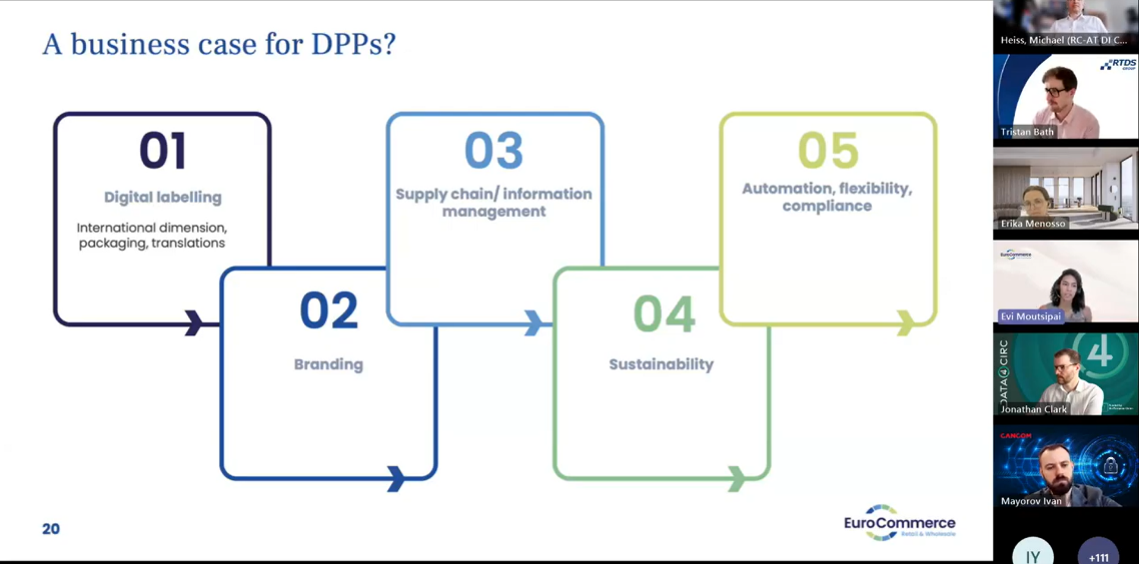
Evi Moutsipai explains some of the business opportunities of DPPs
Business Cases for DPPs:
The next speaker, Prof. Michael Heiss from Siemens, looked at one specific case in which DPPs could constitute an opportunity for businesses: the democratisation of digital twins. What is a digital twin? A digital twin is a “virtual representation of a physical object or system that uses real-time data to accurately reflect its real-world counterpart’s behaviour, performance and conditions” (source: IBM). Michael used a bicycle analogy to explain that, to correctly follow a law or rule such as a DPP requirement, you need a container which will ‘carry’ the necessary information (giving the example of an Asset Administration Shell). It is up to the company etc what they put in the container – companies can add what makes sense for their business to allow them to establish a competitive advantage.
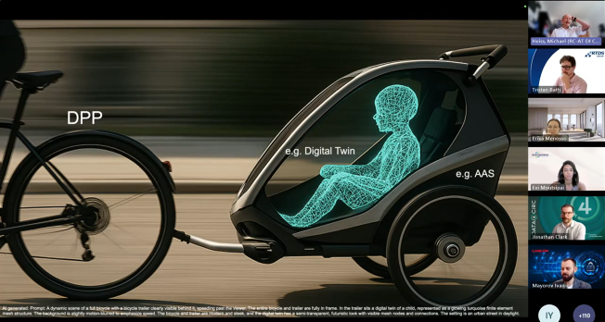
Visualising DPPs as a Bicycle
Michael went on to explain that, by storing dynamic information about a product in a semantic network, accessible by AI, it will tremendously expediate, for example, maintenance, or the onboarding of new devices. He concluded: “I’m convinced that in [a few years], you will not be able to sell a product if you don’t provide the digital twin”.
The third speaker, Ivan Mayorov from CANCOM Austria (representing RecAL), who again addressed the business case within a more specific context, namely ICT and the issue of data sovereignty. With DPPs moving towards reality, the providers of the infrastructure necessary for adoption potentially stand to benefit massively. However, data exchange across the value chain is complicated by the fact that companies are often (quite understandably) reluctant to share sensitive data to centralized third-party platforms. The frameworks being developed both by RecAL and DATA4CIRC (i.e. DATA4CIRC’s Federated Data Space) offer solutions to this which will allow stakeholders to “remain at full control of their data, where the data is stored, how the access policies work”. The value of this lies in the improved sharing of data, which can enable, for example, swifter screening of raw materials, faster Lifecycle Analysis, and reduced costs (energy consumption, virgin raw material use etc).
Next up was Erika Menosso from the Electrolux Group (representing the PSS-PASS project, one of DATA4CIRC’s sister projects). She turned to focus on the consumer and operational phase of DPPs, suggesting that DPP’s true value will be seen with the shift from general product-level data to serial-number-level granularity. This will allow unique events such as repairs, maintenance, or software updates, to be tracked. Such tracking will boost secondary markets, showing that the value extends far beyond the initial sale.
Last, but by no means least, came Dr. Iakovos Yakoumis of MONOLITHOS Catalysts & Recycling Ltd (representing DATA4CIRC). MONOLITHOS is one of DATA4CIRC’s Use Case partners, which will validate the tools and platform being developed by the project’s Technical partners. He focused on the value of DPPs in verifying eco-labelling and differentiating products from competitors, for example, that use toxic materials. Iakovos also pointed to some of the broader societal benefits that DPPs might bring, especially by supporting the circular economy: it is increasingly important to know the source of components or materials to ensure that products are ethically sourced and that black markets are avoided. Additionally, DPPs have the potential to narrow knowledge gaps between SMEs and large companies, letting smaller players access valuable lifecycle and LCA data they could not generate alone.
Panel Discussion
Throughout the Business Case presentations, the experts were actively answering questions submitted by audience members in the meeting chat. Moving to the Discussion section of the programme, the group build on the question: ‘If the ESPR did not exist, would you invest in DPPs?’
Michael Heiss immediately indicated that he would still invest in DPPs on the basis that they are drivers of digital transformation; however, he acknowledged that the investment is made more attractive by the ESPR. There was generally agreement from the rest of the panel that regulation can act as a catalyst for adoption. Ivan pointed out that a lot of data already exists – he noted it is possible to track the origin of every egg in the supermarket in Austria – a key consideration is helping users/consumers make the most of the data that is available. He went on to note that finding incentives that would motivate consumers to access the data are also important, asking the audience to think about when they last scanned a QR code on packaging. Iakovos agreed, though he noted that, even if the business case for end users/consumers has not yet been fully developed, a strong business case may still exist for states, especially in the EU, and producers.
When discussing barriers to DPP deployment, Ivan explained that DPPs are not something that many companies only started looking at in the last few months – they have been working towards them for a longer period. Still, he commented that uncertainties remain, for example over the precise requirements of the registry. Evi agreed it is difficult to design products without clear knowledge of obligations. She added that, the more extensive the obligations, the greater complexity, for example, in ensuring commercially sensitive data is protected, or in establishing differing access agreements for different economic actors. For that reason, she underlined the importance of regulators taking a phased approach.
Michael and Ivan the challenge faced by companies in their current data systems, where data may be siloed in different systems. Michael emphasised that this isn’t just a challenge for SMEs – but also that now is the time address this: companies must ‘do their homework’ on data system architecture design. Attempting to deploy DPPs without the correct structured, unified data model could lead to increased costs and complex Application Programming Interface tangles.
Digging further into the legal implications of DPPs, Evi confirmed that the primary custodian of data in the DPPs is the manufacturer (they must create the DPP and a responsible for the accuracy of the data it contains); however, Erika noted that the situation might become more complicated later in the product’s lifecycle as third parties begin to modify the product and its data. Evi agreed that it is particularly significant for online marketplaces as, in the future, the absence of a DPP could prevent a product legally being listed or sold. In the event that the custodian of a DPP ceases to exist, the DPP ought to still be available. This creates a potential business opportunity for insurance companies or big ICT companies to provide back-up services.
Final Thoughts
As the discussion concluded, the main takeaway from the from the webinar was that there is a business case for adopting DPPs beyond regulatory compliance: creating the architecture for data sharing doesn’t just ‘future-proof’ products in terms of compliance, it provides immediate competitive advantages in terms of efficiency and access to data that might be otherwise unavailable, plus it goes without saying that the shift towards greater circularity will have knock-on effects in terms of the environment! DPPs are a win-win!
The DATA4CIRC project is grateful to all of the participants in the webinar, especially the expert panellists. You can keep up to date on the latest developments from our project by following us on the DATA4CIRC social media channels:
