
International Day of Zero Waste 2026: Introducing the DATA4CIRC Use Cases
Published March 2026 © DATA4CIRC
In previous blogs we have asked ‘what is the circular economy?’, and then gone on to explain the so-called ‘R-strategies’ that are necessary to help us begin transforming a traditional linear economy into a circular economy.
As this month marks both Global Recycling Day and International Day of Zero Waste, DATA4CIRC would like to take a closer look a what the different R-strategies look like in practice, focusing on our Use Cases.
Use Case 1: Recycling Agricultural Plastics

Recycling involves processing old/used materials, classified as waste under Directive 2008/98/EC, to make new raw materials for use in new products. We have already looked at different types of plastic and considered how they present challenges to recyclers. We have also visited project partners Asociación Empresarial de Investigación Centro Tecnológico del Calzado y del Plástico de la Región de Murcia (CETEC) and Green World Compounding SL (GWC) as part of our General Assembly meeting in Murcia in June 2025. Spain is home to the highest concentration of greenhouses in the world – they are visible from space! But, those greenhouses are largely made of plastic sheeting, this also poses significant problems.
GWC is a recycling company specializing in recovery and valorisation of agricultural plastic waste. The company produces and markets recycled pellets and regrinds for the manufacture of new plastic products. It transforms plastic waste into high-quality recycled materials, turning an environmental challenge into a practical solution and extending the lifecycle of plastics. As part of this effort, GWC participates in the DATA4CIRC project, collaborating with CETEC on Use Case 1. The goal of their involvement is to validate the project’s digital solution and help Use Case 1 address the numerous challenges posed by agricultural plastic waste, including high degradation and contamination upon collection. This support enables optimization of the recycling process and the production of high-quality recycled products, demonstrating how the digital solution helps close the loop on agricultural plastics more efficiently
The recycling process includes several stages: collection of agricultural waste plastics, pretreatment (shredding, washing, and drying), and extrusion, carried out by GWC as the recycler to produce high-quality recycled pellets. These pellets are then transformed into final plastic products for end-users by CETEC, the converter.
To the extent that it prevents material from being lost to the value chain as waste at the end of life of a product, recycling is an important and valuable tool for reducing pollution and improving the environmental footprint of products made using the recycled material. The integration of DATA4CIRC technology in CETEC and GWC’s workflows will demonstrate how DATA4CIRC’s framework has the potential to further enhance traceability, improve waste management, and provide lifecycle environmental impact analyses, paving the way for a more sustainable plastics industry.
Use Case 2: Recovering Waste from Electrical and Electronic Equipment (WEEE)
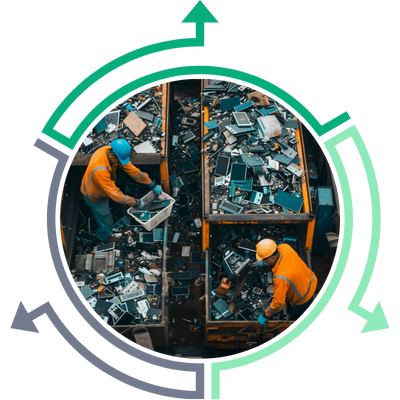
Our project partners Gruppo FOS, and Eco Recycling extend the life cycle of electronic products and minimise e-waste by recovering valuable elements from secondary raw materials from WEEE, waste, and residues. Gruppo FOS’s T&G Repair & Re-manufacturing (R2) Centre is a leader in the repair of electronic circuit boards and specialises in restoring obsolete or out-of-production spare parts. The centre also features dedicated remanufacturing facilities for BGA components and operates a Swap Warehouse. Repair extends a product’s life by fixing defects and avoids premature disposal/waste. Remanufacturing involves rebuilding products using a combination of reused, repaired, and new parts to return products to their original (or better) condition. When repair is not feasible due to high costs or lack of spare parts, equipment is carefully disassembled to recover valuable components, which are then reintegrated into the Swap Warehouse.
Whilst these processes might ordinarily generate some waste, including faulty components and materials, instead of discarding this material, Eco Recycling applies hydro-metallurgical processes to recover valuable secondary raw materials. These processes are carried out in the company’s advanced technological platform, which is equipped with several self-designed pilot-scale plants tailored to different processing needs. Through these treatments, Eco Recycling efficiently extracts target components, such as those from e-waste, including PCB boards. The recovered materials are then reused to produce new electronic components, contributing to the creation of a sustainable closed-loop system.
DATA4CIRC’s framework will provide assurance to end consumers that products containing recovered materials have been properly processed. It will also enable future recyclers and other stakeholders to better understand the materials used in these products and how to handle them safely.
Use Case 3: Refurbishing Automotive Catalytic Converters
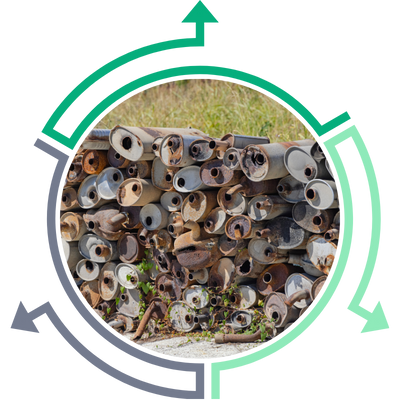
Refurbishing involves the update of products to extend their life spans and enable extended use. DATA4CIRC’s partners Centro Ricerche Fiat (CRF) (part of the Stellantis Group) and MONOLITHOS, whose premises we visited in Athens as part of our General Assembly meeting in November 2025, are turning old into new by recycling spent catalytic converters, recovering platinum group metals, and re-manufacturing fresh, high-performance automotive catalysts using innovative processes while reducing the need for virgin raw materials .
MONOLITHOS spearheads the collection, sorting, and preprocessing of spent catalytic converters across Greece. Its facility can process up to 40,000 units annually. Using its patented chlorine-based hydro-metallurgical approach, MONOLITHOS efficiently recovers Platinum Group Metals (PMGs), such as platinum (Pt), palladium (Pd), and rhodium (Rh), with high recovery yields. The resulting leachate, containing the recovered PGMs, is directly reused without further refining for the production of new catalytic converters. In the remanufacturing process, PGMs are partially substituted with copper (Cu) nanoparticles, enabling a significant reduction in the use of critical raw materials while maintaining catalytic performance comparable to original equipment manufacturer (OEM) standards. This approach not only ensures the recycling of valuable PGMs but also reduces the quantity required for the production of new catalysts.
CRF supports the testing and validation of the newly developed catalysts, ensuring compliance with strict environmental regulations, industry standards, and market requirements.
In addition, the DATA4CIRC framework enhances the traceability of refurbished catalytic converters through the implementation of a digital tools (Digital Product Passport, Digital Twin &Digital Thread), ensuring traceability, transparency and strengthening the competitiveness of the automotive sector.

We hope you are as excited as we are to follow the DATA4CIRC journey over the next 4 years! You can keep up to date on the latest developments from our project by following us on the DATA4CIRC social media channels:
