
Meeting DATA4CIRC Project partner MONOLITHOS in Athens, Greece
Published Dec 2025 © DATA4CIRC
The DATA4CIRC partners gathered together in Athens, Greece, from 19th-20th November for their second General Assembly meeting – the first was in Murcia, Spain back in June. It was a great opportunity to catch up with colleagues from our project and hear about all the work they’d been doing. Read on to find out what we got up to (and maybe learn a few fun facts about mythology and history!)
A fitting location for an EU-funded research project
Etymologically, Athens felt like an especially fitting location for an EU-funded research initiative dedicated to advancing the circular economy. According to Greek mythology, the city is named after Athena, the patron goddess of heroic endeavour and an international symbol of wisdom. Europe’s name is also rooted in Greek mythology: Europa, the Phoenician princess whose story gave the continent its title, symbolises connection, discovery, and transformation. In some ancient traditions, Europa was also an epithet for Demeter, the Greek goddess associated with the cycle of life, renewal, and the sustainable balance between people and the natural world. What could be a more fitting background given DATA4CIRC’s endeavour to harness the power of information to transform material flows and unlock new circular value chains through data-driven innovation!
Gathering at the headquarters of our project partner MONOLITHOS, organisers and hosts of the General Assembly meeting, we were reminded that Europe’s mythological origins and Demeter’s cyclical symbolism continue to echo in today’s ambitions for greener, more resilient systems. The meeting kicked off with a short introduction to MONOLITHOS’ work and their role in the project, in particular their contribution to our work recovering valuable metals from spent catalytic converters to be used in fresh, high-performance automotive catalysts.

The Greek goddess Demeter
Introducing MONOLITHOS
MONOLITHOS’ CEO and founder Iakovos Yakoumis gave a background to his company, which specialises in recovering and recycling critical and strategic raw materials (CRMs) and using them to produce advanced catalytic materials for automotive, naval, energy, and tire applications. MONOLITHOS uses a novel, environmentally friendly hydro-metallurgical method with high recovery rates to selectively recover metals from end-of-life (EoL) devices. MONOLITHOS has the experience and facilities necessary for scaling up catalyst production and material recycling. With over seven years of active R&D, MONOLITHOS has secured 5 patents, published more than 30 peer-reviewed papers, and taken a leading role in European industrial innovation by coordinating 12 projects and contributing to over 40 others. The company recently achieved ISO 9001:2015 certification for the production of automotive catalytic converters and successfully homologated the Prometheus Catalyst, the first copper-based emission control catalyst for Euro 6b vehicles, which reduces platinum group metal (PGM) content by 85% while maintaining exceptional performance and durability.
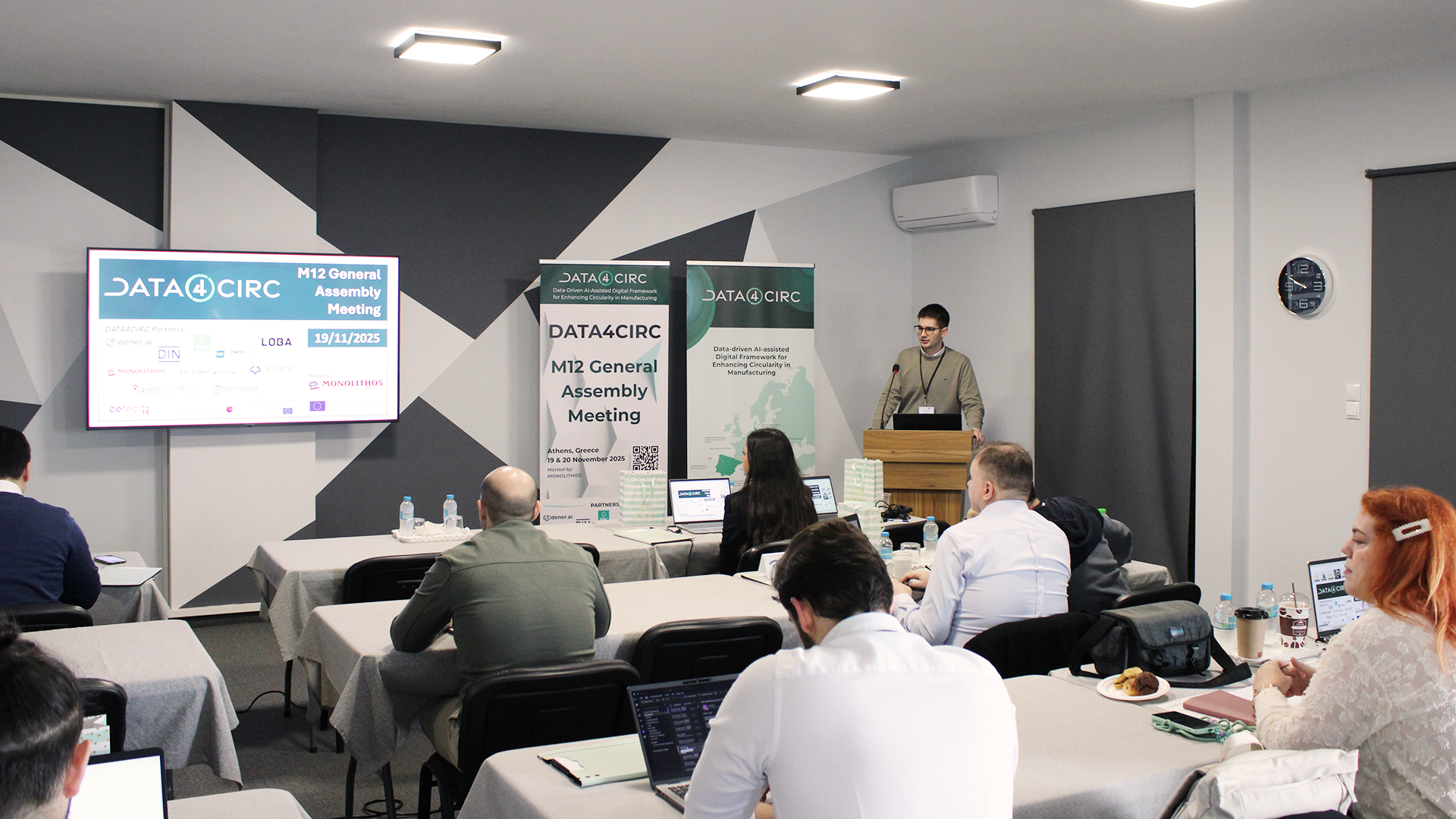
DATA4CIRC Project Coordinator Álvaro Ojeda opens the General Assembly © DATA4CIRC 2025
What is the status of the DATA4CIRC project?
The meeting continued with a review from each of the project’s 9 work packages. Key highlights included:
- Achieving milestones in team and technology alignment, setting out the key requirements and functional specifications for the project’s digital framework. This included selection of architectures such as the use of the Asset Administration Shell (AAS).
- Collaboration with various other EU-funded research projects to organise events, such as the webinar on Digital Product Passports and cooperation and exchange with our sister projects to establish technical synergies.
- Demonstration of a model which simulates the onboarding process for organisations that will eventually use the DATA4CIRC data-sharing portal. Developing this has involved proposing methodologies for data characterisation, identifying a framework for ontologies, and the adoption of a hub-and-spoke model to coordinate centralised policy control with decentralised data storage and management. The portal will also integrate a Circular Orchestration Engine.
- Explanation of the blueprints developed for the federated dataspaces, Digital Twins and Digital Threads, Digital Product Passports, and AI-assisted Lifecycle analysis tool. These include mapping of requirements and compliance paths.
Each work package also laid out their action plan for the next six months. Just as Demeter presided over the cycles that sustained ancient societies, DATA4CIRC’s work to date is setting a pathway for how data can be used to illuminate and strengthen the modern cycles that will sustain Europe’s future: keeping resources in use, prolonging value, and nurturing the ecosystems in which industries operate.
After the reports from the technical work packages, the meeting progressed to Monolithos’ research and production facilities, where we were given a tour of the site and the processes of disassembly, material recovery and waste reduction were explained.
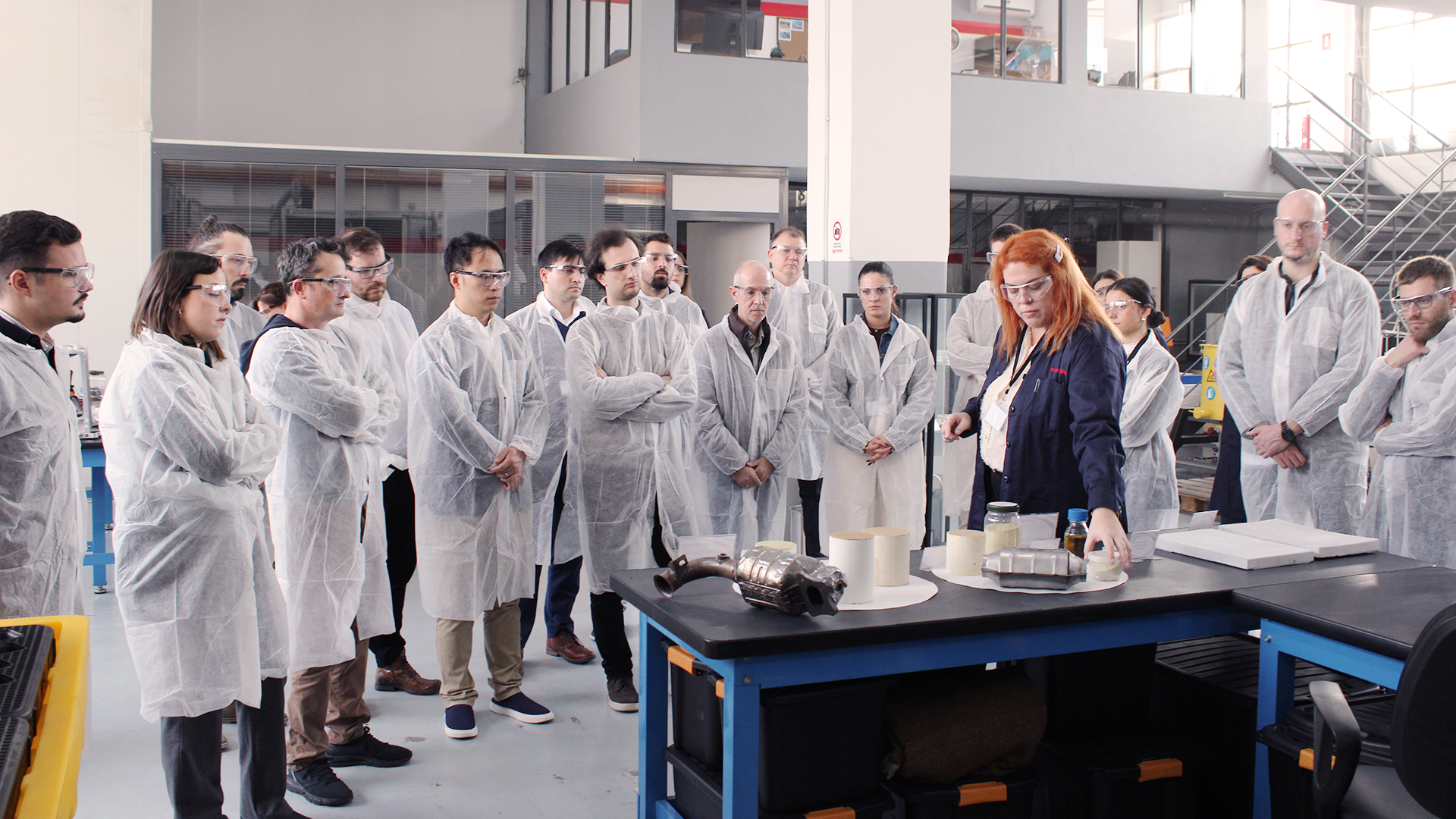
The DATA4CIRC team being shown MONOLITHOS’ research and production facilities © DATA4CIRC 2025
Thanks to the digital tools DATA4CIRC is developing, MONOLITHOS will be able to better trace the origin, content, and prior uses of the materials they are recycling and guarantee safety and quality for end consumers. They will also be able to demonstrate regulatory compliance with future EU legislation, ensuring their products access to the market.
With these ideas still fresh in our minds, we were allowed a few hours of free time and the shift from meeting rooms to the vibrant streets of Athens offered a energising transition. Exploring the city, with its layers of history, culture, and innovation, it was impossible not to notice how layers of history remain visible – classical Greek temples beside Roman structures, Byzantine churches and Ottoman baths emerging on modern streets. Each era leaves traces that help us understand how buildings have been used, adapted, and repurposed over time. In much the same way, DATA4CIRC will use digital product passports to allow future ‘generations’ (or users) to read the “architectural layers” of the products and materials we use today. By making information on a material’s origins, composition, and past applications accessible and transparent, digital product passports will preserve knowledge that would otherwise be lost. This will help ensure that resources can be reused intelligently, much like the city of Athens has continually transformed and rebuilt upon the foundations of its past. Another reminder that cycles of renewal, adaptation, and reinvention are at the heart of European identity!
The General Assembly programme resumed with a shared dinner for the partners, providing space to continue conversations in a more informal setting, strengthening the collaboration that underpins DATA4CIRC’s success.
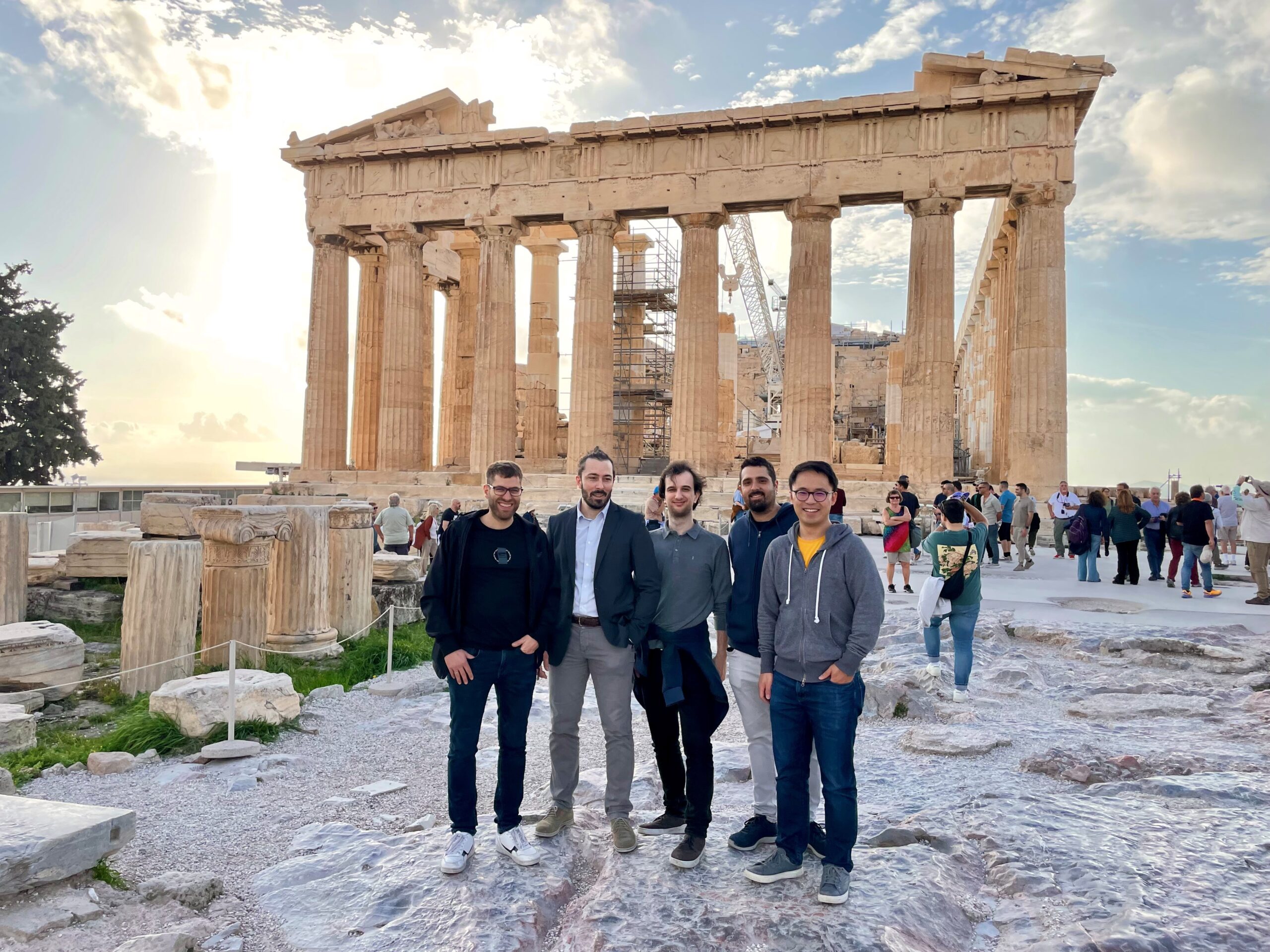
Some of the DATA4CIRC team taking the opportunity to visit the Acropolis, Athens, Greece (reproduced with permission)
Day Two of the General Assembly began with a stakeholder workshop led by project partners EIT Manufacturing and LOBA. The objective was to better understand the needs of different groups of stakeholders and develop criteria to help refine future messaging. The workshop aimed to map motivations, challenges and behaviours for each group and synthesize actionable personas to guide the development of a business plan in the latter half of the project. The workshop participants were highly enthusiastic, which allowed for the convergence of diverse perspectives in a structured, interactive environment and promoted co-production of knowledge by engaging all consortium partners and their unique perspectives/needs/goals.
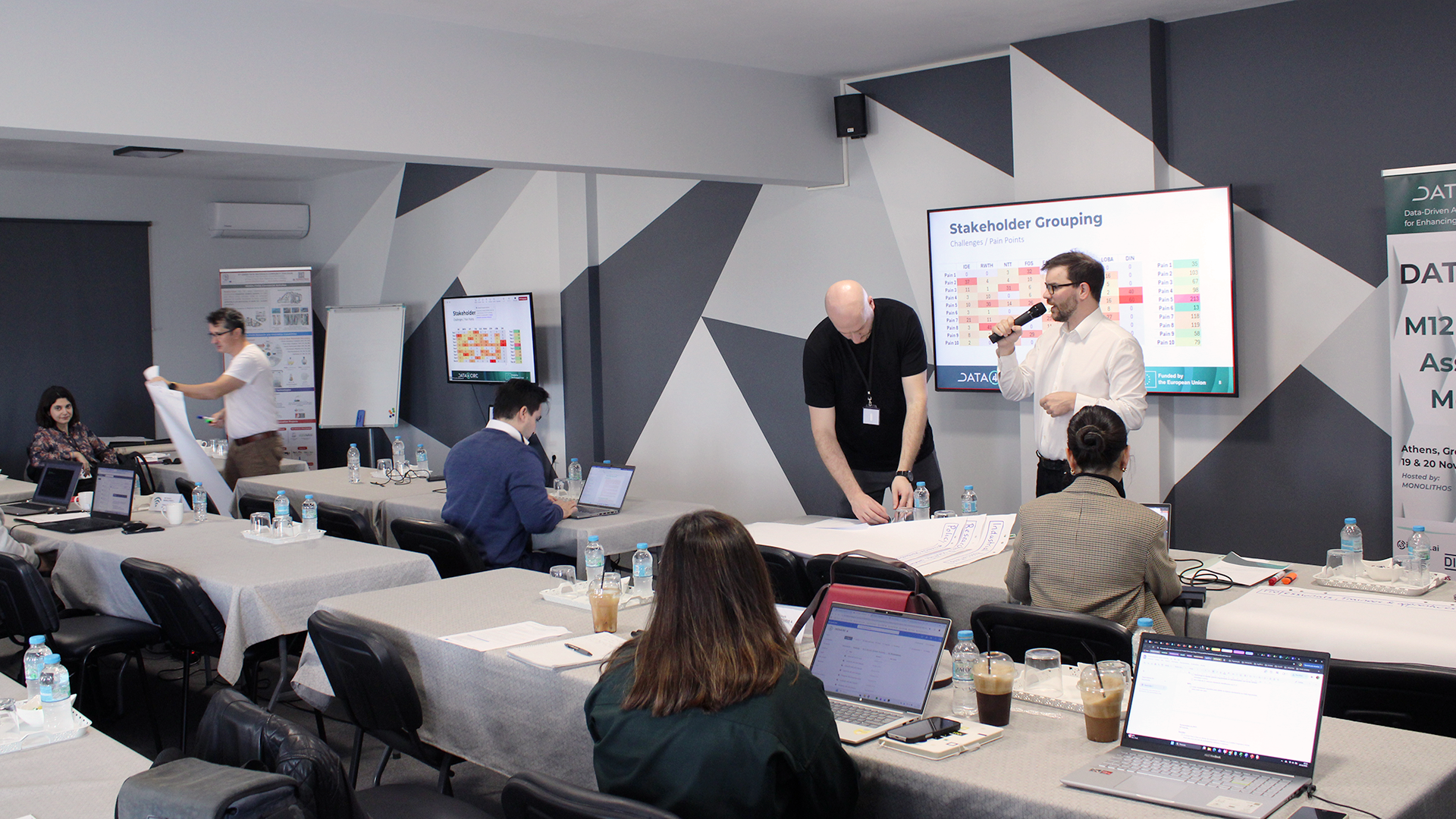
The DATA4CIRC team, led by representatives from EIT Manufacturing East GmbH and LOBA, participate in a workshop to identify and refine understanding of the project’s stakeholders © DATA4CIRC 2025
The General Assembly concluded with a round up of the next steps and a reiteration of the actions and responsibilities for each work package.
Based on the positive atmosphere in the room, it really did seem as though a little bit of Demeter’s power of creativity was in the air. The next three years of DATA4CIRC are really something to be looked forward to as the project continues to grow and begins to bear fruit!
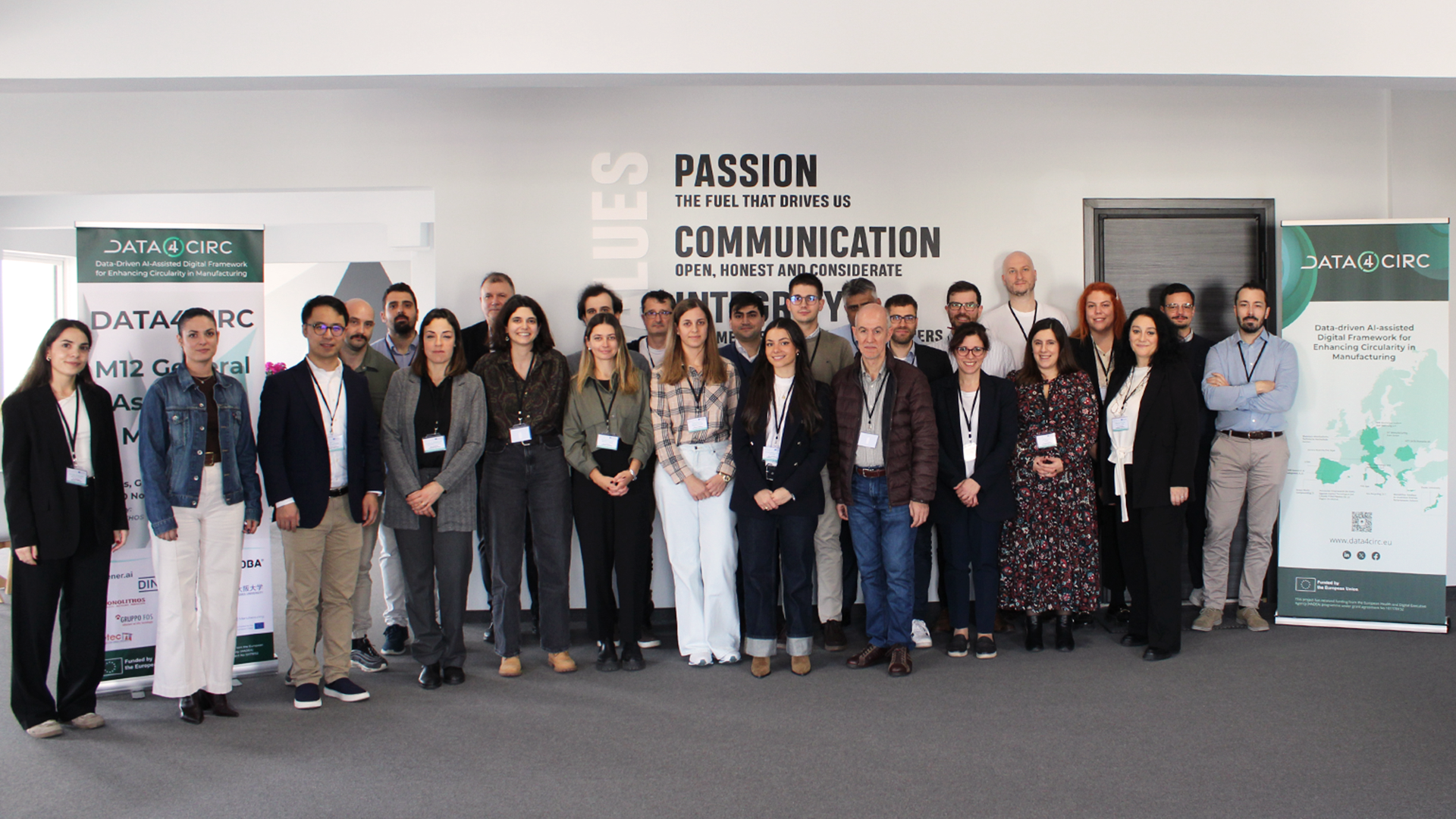
The DATA4CIRC team take a group photo after their General Assembly meeting in Athens, Greece, November 2025 © DATA4CIRC 2025
We hope you are as excited as we are to follow the DATA4CIRC journey. You can keep up to date on the latest developments from our project by following us on the DATA4CIRC social media channels:
