
From Data to Digital Twins: Turning Industrial Data into Action
Published November 2026 © DATA4CIRC
In August’s blog, The invisble thread: why the circular economy needs to connect processes, we explored how Digital Threads connect information across a product’s lifecycle, overcoming the barriers created by fragmented industrial data. But once this information is connected, what can we actually do with it?
What if, beyond tracing a material’s history, we could understand how an industrial process behaves and explore how it might respond to different operating conditions? This is where Digital Twins come into play, transforming industrial data into insights that support better decisions.
Giving Industrial Processes a Digital Counterpart
Imagine having a virtual representation of an industrial process that allows you to observe its performance and investigate possible improvements. For example, in a recycling plant, combining information about incoming materials, operating conditions, and recovery results could help identify which parameters influence material recovery efficiency.
This is the idea behind a Digital Twin (DT): a digital representation of a physical product, process or system, supported by real-world data and analytical models.
Think of it as a virtual laboratory. Instead of relying exclusively on physical experiments, a Digital Twin equipped with simulation capabilities allows us to explore different scenarios and evaluate their potential outcomes.
How does this relate to the Digital Thread? Returning to the railway analogy introduced in our blog on Digital Threads, if the Digital Thread provides the network connecting the different stages of a product’s journey, a Digital Twin could represent the operations of a particular station, helping us analyse its performance and explore possible changes.
Together, these technologies connect a product’s history with a deeper understanding of the processes involved.
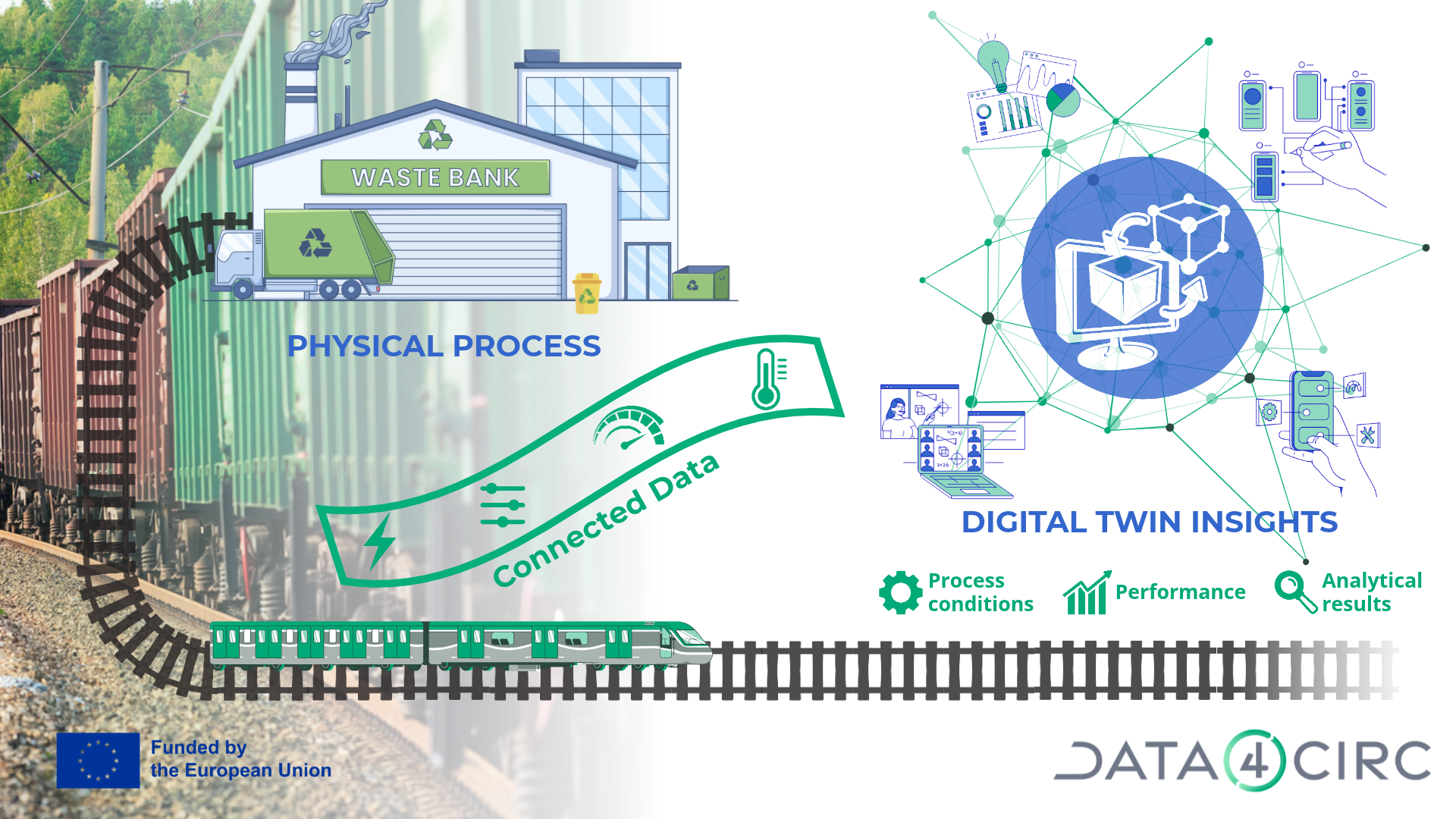
Digital Twins represent real-world products, processes or systems, allowing different scenarios to be tested
From Requirements to Implementation
Creating a Digital Twin does not necessarily mean building a complex 3D model or installing hundreds of sensors. It starts with understanding the physical process and identifying what we want to learn from it. What materials enter and leave the process? Which operations are performed? What parameters influence the results? And which information is already available?
These questions help define the digital model and identify the data needed to support it.
Industrial information may come from sensors, spreadsheets, laboratory measurements, or manually recorded data. While some processes generate continuous measurements, others rely on periodic observations or batch-level records. Not every Digital Twin requires real-time monitoring: its design depends on the process, the available information, and its intended purpose.
Within DATA4CIRC, this approach is being explored across three industrial value chains: agricultural plastics recycling, electronic equipment repair and recycling, and catalytic converter refurbishment.
Despite their differences, the development follows a common path: understanding process requirements, organising available data and progressively building digital models with monitoring, visualisation, and simulation capabilities.
Turning Information into Circular Decisions
A Digital Twin becomes particularly valuable when it helps translate process information into practical decisions.
Imagine a recycling facility trying to improve its material recovery efficiency. Rather than testing every possible operating condition on the physical process, a suitable simulation model could help compare alternative scenarios and identify promising adjustments. Similarly, analysing relationships between manufacturing parameters and product performance can reveal opportunities to reduce waste, optimise resource consumption, or improve product quality.
However, it is important to distinguish between observed data, which describes what has actually happened, and simulation results, which estimate what could happen under specific assumptions. The reliability of simulation results depends on the quality of the data and the underlying models.
For circular manufacturing, these capabilities can support decisions affecting material recovery, product quality, and resource efficiency. They can also complement other digital solutions, such as Digital Product Passports and Life Cycle Assessment tools, contributing to a broader understanding of products and their environmental impacts. Rather than replacing human expertise, Digital Twins provide operators, engineers, and decision-makers with additional information to evaluate alternatives and make informed choices.
From Connected Data to Smarter Circularity
Digital Threads and Digital Twins offer complementary ways to make industrial information more useful. While Digital Threads connect data throughout a product’s lifecycle, Digital Twins use relevant information to analyse processes and explore potential improvements.
Together, they can support more efficient operations, reduce waste, and help keep valuable resources in circulation.
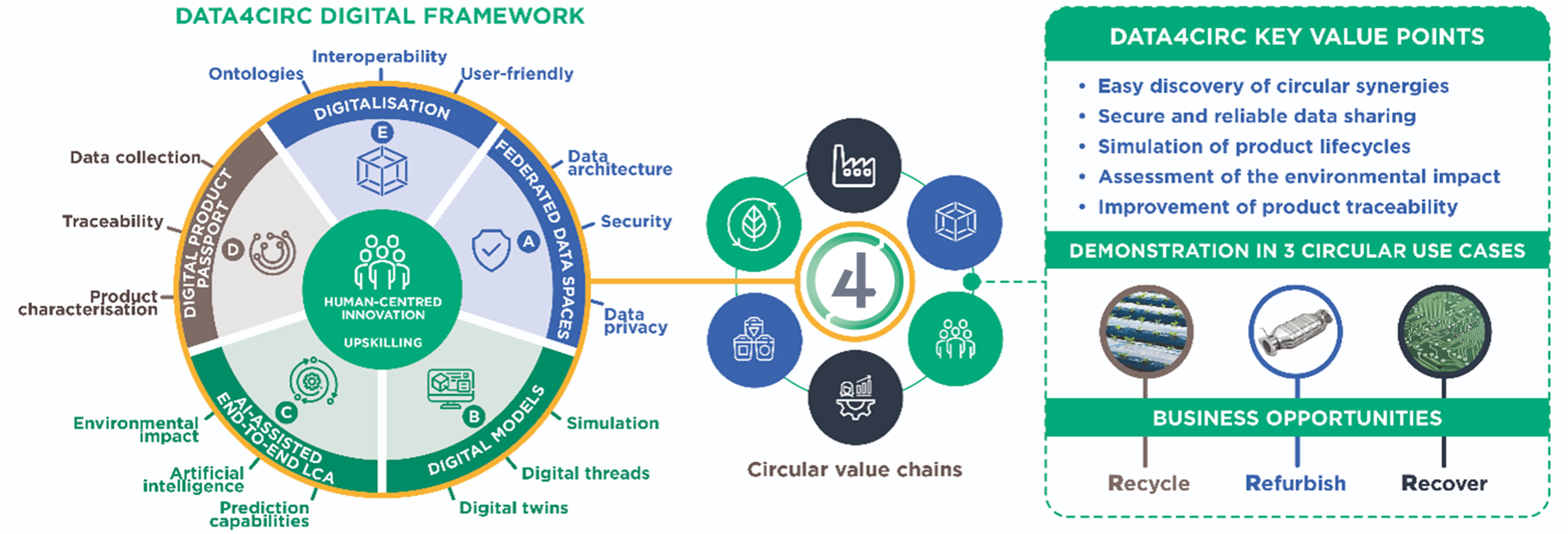
Digital Models form one part of DATA4CIRC’s digital framework for circularity © DATA4CIRC
Keep up to date on the latest developments from our project by following us on the DATA4CIRC social media channels:
