
From Repair to Resource Recovery: Closing the Loop for Electronic Equipment
Published October 2026 © DATA4CIRC
Electronic equipment often reaches the end of its useful life long before the components contained within it lose their value.
A faulty electronic board, for example, does not necessarily need to become waste. In many cases, it can be repaired, re-manufactured, or used as a source of spare components. But what happens when repair/re-manufacture/reuse is no longer technically or economically viable?
This is where the circular economy takes things one step further: from extending the life of products to recovering the value of the materials they contain.
Within DATA4CIRC Use Case 2, T&G (part of Gruppo FOS) and Eco Recycling are working together to demonstrate this transition, connecting repair and re-manufacturing activities with innovative approaches for the recovery of valuable materials from electronic waste.

Aerial view of Eco Recycling’s Pilot Plant © Eco Recycling s.l.r.
Keeping electronic equipment in use for longer
T&G’s Repair and Remanufacturing (R2) Centre specialises in extending the lifetime of obsolete or out-of-production electronic components, including Printed Circuit Boards (PCBs).
When a faulty board arrives at the R2 Centre, the first objective is not recycling. It is to understand whether the product can be given a second life.
The board is registered and diagnosed, and its condition is assessed to determine the most appropriate pathway. When possible, the component is repaired and tested before being returned to the customer. Repair activities can include operations such as replacing damaged components or carrying out specialised rework activities, including Ball Grid Array (BGA) rework.
When conventional repair is not possible, remanufacturing may provide another option. Components can be replaced using new parts, items available in T&G’s inventory, or components recovered from other faulty boards. This approach allows components that would otherwise become waste to remain within the value chain.
T&G’s activities are supported by a structured traceability system. Information such as part numbers, serial numbers, fault descriptions, repair activities, and shipping data is recorded throughout the process. This information is important not only for quality management, but also for understanding what happens to products and components throughout their journey.

Repairing a PCB
When repair reaches its limits
Not every board can be repaired or re-manufactured. Sometimes the damage is too extensive. In other cases, replacement components are no longer available, or the cost of the intervention is no longer economically justified. At this point, dismantling can provide another circular pathway.
Usable components can be recovered and placed in T&G’s inventory, where they may later be used in other repair activities. Depending on the specific situation and ownership arrangements, the remaining material may be returned to the customer or managed as Waste from Electrical and Electronic Equipment (WEEE). This is the point at which the collaboration with Eco Recycling becomes particularly relevant.
Rather than looking at the board only as a waste item for disposal, Eco Recycling shifts the focus towards seeing the value of the materials and elements contained within it.
From WEEE to secondary raw materials
Eco Recycling is an engineering company specialised in the development and validation of innovative recycling processes. Its work focuses on hydrometallurgical technologies capable of recovering valuable components from different waste streams, including WEEE, batteries, and photovoltaic panels.
For electronic waste, the objective is to develop processes capable of selectively recovering valuable materials and producing outputs with characteristics that can potentially allow them to re-enter the relevant market as secondary raw materials.
Within DATA4CIRC’s Use Case 2, the workflow therefore connects two complementary capabilities:
- T&G starts from the product.
The company works to diagnose, repair, re-manufacture or dismantle an electronic board, keeping the product and its components in use for as long as possible.
- Eco Recycling starts from the material.
When a board can no longer be repaired or its components cannot be reused, the relevant WEEE stream can be directed towards recycling research and process validation. At Eco Recycling’s technological platform, pilot plants and modular prototypes are used to test innovative hydrometallurgical processes under controlled conditions.
Depending on the process being investigated, parameters such as pH, temperature, pressure, contact time and liquid levels can be monitored during the experimental campaign. The resulting products are then analysed to assess characteristics such as purity, physical form and particle size.
The aim is not simply to remove waste from the system. It is to recover value from it.
Closing the loop
The collaboration between T&G and Eco Recycling illustrates an important principle of circular economy thinking: recycling should not necessarily be the first option, but it should be part of a hierarchy of strategies for retaining value.
A simplified pathway can be represented as:
Repair → Re-manufacture → Component Reuse → Material Recovery → Secondary Raw Material
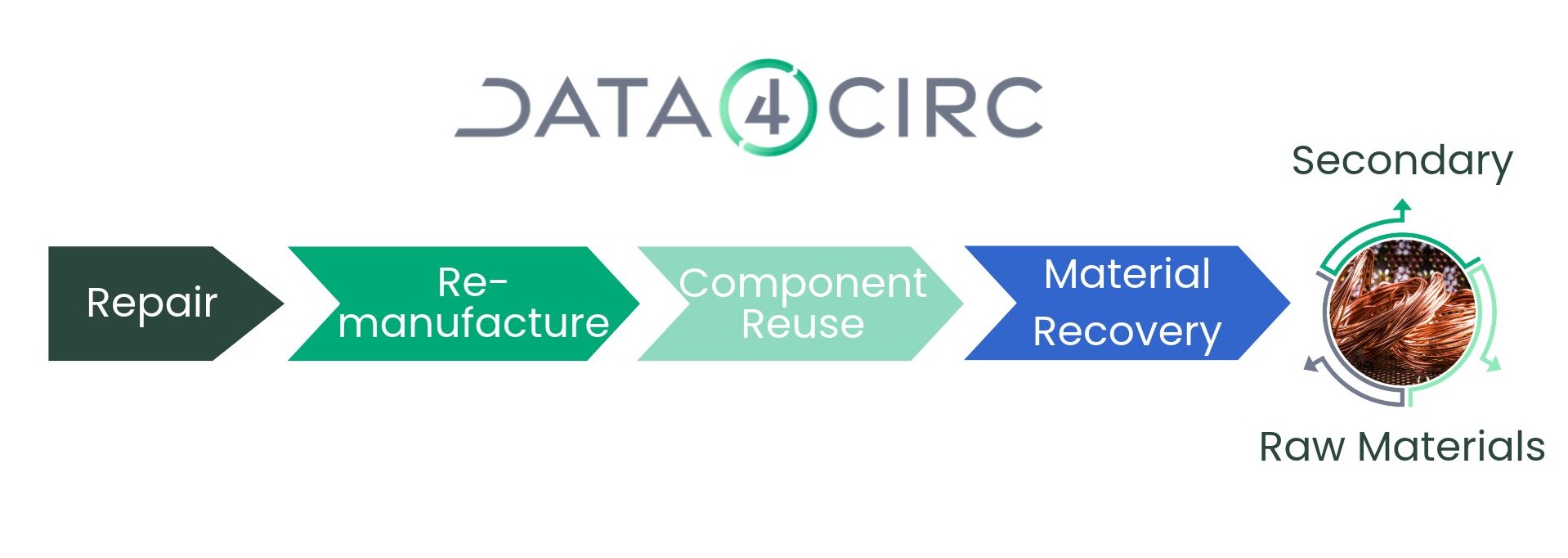
A simple way to imagine pathways to maintaining value © DATA4CIRC 2026
The earlier stages aim to preserve as much of the original product and component value as possible. When this is no longer feasible, material recovery provides another opportunity to retain value within the system. This creates a connection between activities that are often siloed: repair companies deal with products and components; recycling technologies deal with materials. A circular value chain needs both perspectives.
Data as the link between physical and circular value chains
One of the less visible but essential elements of this process is data.
At T&G, information collected during repair and re-manufacturing activities provides traceability for boards, components, faults, interventions, and outcomes.
At Eco Recycling, experimental campaigns generate another layer of information: process parameters, material flows, analytical results, recovered product characteristics, and data needed to assess the technical and economic feasibility of the process.
Connecting these different types of information can support a more transparent understanding of what happens to an electronic product throughout its circular journey.
Within DATA4CIRC, digital tools such as Digital Product Passports (DPPs), Digital Twins (DTs) and the online Life Cycle Assessment (LCA) tool could help Eco Recycling address key challenges in waste management and material recovery. Access to more structured information on the composition and history of incoming electronic waste could support better waste characterisation, treatment selection and process optimisation. Digital Twins could help monitor and analyse pilot-scale recycling processes, while the LCA tool could help assess their environmental impacts and compare alternative recovery routes, identifying opportunities to reduce resource consumption and emissions. Together, these tools can support more informed technical decisions, improve process efficiency and provide evidence of the environmental performance of innovative recycling solutions, contributing to more transparent and sustainable circular value chains.
In this sense, digitalisation is not an objective in itself. It becomes an enabler for circularity by helping actors understand where a product or material is, what has happened to it, and what its next possible use could be.
Measuring whether circularity is actually delivering environmental benefits
The recovery of material does not automatically mean that a process is environmentally preferable: Life Cycle Assessment (LCA), together with technical and economic feasibility studies, can help evaluate whether an innovative recovery route can provide environmental benefits when compared with conventional alternatives. This is an important step in moving from the idea of circularity to measurable circularity.
The objective is therefore not simply to recover copper, precious metals, or other valuable materials. It is to understand how efficiently they can be recovered, what resources are required, what residues are generated, and whether the overall process can contribute to a more sustainable value chain.
From a linear journey to a circular pathway
The story of an electronic board does not have to end when it stops working. It can be diagnosed and repaired. If repair is not possible, it can potentially be re-manufactured. Components can be recovered and reused. And when neither the product nor its components can be saved, the materials themselves can become the starting point for a new process.
This is the circular pathway that DATA4CIRC Use Case 2 aims to demonstrate: connecting repair, re-manufacturing, component reuse and material recovery into a single value chain.
The collaboration between T&G and Eco Recycling shows that closing the loop for electronic equipment is not about one single technology or one single stage of the product life cycle. It requires different actors, processes and types of expertise to work together.
Ultimately, the goal is simple: keep products in use for longer, recover the value that cannot be preserved, and give materials another opportunity to become part of the production cycle.
That is how a faulty electronic board can become more than waste: it can become a resource.

Keep up to date on the latest developments from our project by following us on the DATA4CIRC social media channels:
